What Is the 3-3-3 Rule for Stress? The Quick Grounding Technique
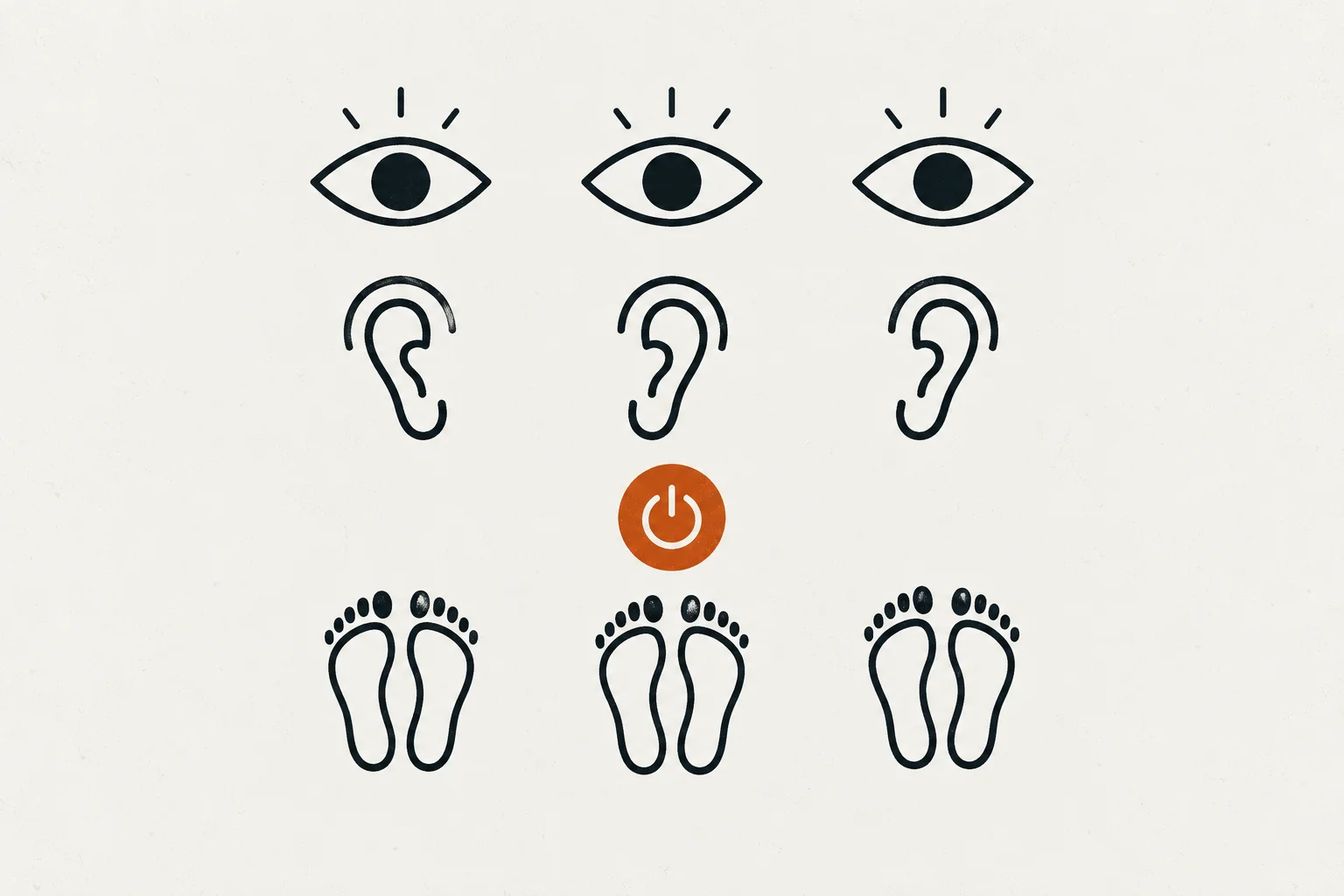
The 3-3-3 rule for stress is a brief sensory exercise: notice three things you see, identify three sounds, and move three parts of your body. It can interrupt mental overload long enough to help you choose what to do next.
Treat it as a reset, not a treatment. The exercise does not remove the deadline, resolve a conflict, or build a complete stress-management plan. Its job is to create a short transition from automatic reaction to deliberate action.
The stress version in 30–90 seconds
- Name three things you see. Use neutral detail: “a blue folder,” “light on the wall,” “a silver door handle.”
- Name three sounds you hear. Notice nearby and distant sounds without judging them.
- Move three parts of your body. Roll your shoulders, uncurl your fingers, and press both feet into the floor.
Then ask: What is the next useful action I can take? That final question makes this a stress reset rather than an isolated grounding ritual.
What grounding can and cannot do
Grounding directs attention toward current sensory information. The U.S. Department of Veterans Affairs National Center for PTSD describes grounding as focusing on sensations in the body and environment to reconnect with the present moment.
That provides a reasonable basis for trying a simple sensory sequence. It does not establish the branded “3-3-3” sequence as a validated clinical treatment, and there is no good basis for promising that it will reduce stress by a particular percentage or within an exact number of seconds.
For everyday situational stress, the exercise may help you pause, orient, and loosen physical tension. If it makes you more frustrated, dizzy, detached, or distressed, stop. VA guidance on grounding also notes that a technique should be adjusted or abandoned if it worsens the situation.
When to use the 3-3-3 rule for stress
This version fits moments when pressure is immediate and you still need to act:
- Before responding to a tense message.
- Between back-to-back meetings.
- When a crowded to-do list has frozen your attention.
- After an argument, before deciding what to say next.
- At the end of work, when you need to transition into home life.
It is less useful as the only response to chronic workload, unsafe conditions, financial strain, caregiving demands, or persistent sleep disruption. Those stressors require problem-solving, support, boundaries, or professional care rather than repeated resets alone.
Add a next step after grounding
If the stressor is solvable now
Choose one action that takes less than 10 minutes. Clarify the request, write the first sentence, move one appointment, or ask for the missing information. Do not use the calmer moment to rebuild the entire plan.
The NHS problem-solving guide recommends separating practical problems from hypothetical worries, then making a specific plan for problems you can influence.
If the stressor is solvable later
Write down what needs to happen, who is involved, and when you will address it. A scheduled action gives your attention somewhere concrete to return.
If the stressor is outside your control
Choose a recovery step: take a short walk, contact someone supportive, or use a longer relaxation practice. The aim is not to pretend the stressor does not matter. It is to stop rehearsing it continuously when no immediate action is available.
Pair the reset with one longer-term strategy
A 3-3-3 reset becomes more useful when it leads into a broader plan. Depending on the source of stress, that may include:
- Movement: Regular physical activity can support mood, sleep, and health. The CDC notes that even some activity provides benefits and that a single moderate-to-vigorous session can reduce short-term feelings of anxiety for adults.
- Breathing practice: The NHS breathing exercise uses gentle, unforced breathing and recommends regular practice.
- Problem-solving: Define one controllable problem and its next action.
- Social support: Tell a trusted person what kind of help you need—listening, practical assistance, or a decision check.
- Professional support: Seek help when stress is persistent, overwhelming, or impairing daily life.
Our guide to seven ways to manage stress helps you choose across these areas. For movement specifically, see effective exercises for managing stress.
How this differs from the 3-3-3 rule for anxiety
The sensory sequence is the same, but the purpose differs.
The 3-3-3 rule for anxiety is framed as an acute orienting tool when anxious attention is pulled into threat predictions or feels unmoored from the present. It is not a validated treatment for an anxiety disorder.
The stress version addresses situational pressure. It creates a pause, then moves directly into a decision: act on the stressor, schedule it, or recover from it. Keeping those purposes separate prevents two near-identical articles from making the same promise.
Common problems and adjustments
“I cannot find three sounds”
Use subtler sounds: airflow, clothing moving, your footsteps, or distant traffic. You can also name three physical sensations instead.
“Counting makes me more tense”
Drop the number. Name one sight, one sound, and one body sensation. The count is a memory aid, not a clinical requirement.
“I feel calmer, then the stress returns”
That is expected when the source remains. Use the calmer interval to choose the next practical or supportive step instead of repeating the exercise indefinitely.
When to get help
Talk with a health professional when stress is persistent, contributes to panic or depressed mood, disrupts sleep or functioning, or leads you to rely on alcohol or other substances. Seek urgent help if you feel unable to keep yourself safe; in the United States, call or text 988.
The bottom line
The 3-3-3 rule for stress is a short attention-and-movement reset. Use it to notice your surroundings, release a little physical bracing, and create room for one useful decision.
It works best as a doorway into stress management, not as a substitute for it. Reset, name the kind of stressor you are facing, and choose the next step that fits.
This article is educational and is not a diagnosis or a substitute for professional medical or mental health care.