What Is a Good Book to Help Me Stop Anxiety? A Personalized Recommendation Guide

The right anxiety book depends on your specific symptoms, not a one-size-fits-all recommendation. This guide matches book types to anxiety types — helping you find the resource that actually fits your situation.
Why There’s No Single “Best” Anxiety Book
Anxiety isn’t one condition. It’s a cluster of related disorders with different mechanisms and treatment needs:
- Generalized Anxiety Disorder (GAD): Chronic, excessive worry about everyday things
- Social Anxiety Disorder: Fear of social situations and judgment
- Panic Disorder: Recurrent panic attacks with fear of future episodes
- Specific Phobias: Intense fear of particular objects or situations
- Overthinking/Rumination: Persistent, uncontrollable mental loops
A book that works for social anxiety won’t necessarily help panic disorder. Matching the book to your specific anxiety pattern increases your chances of success.
Quick-Start: Match Your Anxiety Type
| Your primary symptom | Start with this book |
|---|---|
| Chronic worry that won’t stop | The Anxiety and Worry Workbook by David Burns |
| Fear of social situations | The Shyness and Social Anxiety Workbook by Anthony D’Amico |
| Panic attacks and fear of physical symptoms | Panic Relief Now by Barbara Rothbaum |
| Racing thoughts and overthinking | Brain Off Switch (100 practical techniques) |
| Anxiety with low mood | Feeling Good by David Burns |
| Tired of fighting your thoughts | The Happiness Trap by Russ Harris |
| Anxiety with trauma history | Don’t Let the Lion Sleep Tonight by Alan Aldridge |
For Chronic Worry (GAD)
Top pick: The Anxiety and Worry Workbook by David H. Burns, M.D.
This is the book most clinicians recommend for GAD. It teaches you to:
- Identify the cognitive distortions that fuel chronic worry
- Use the downward arrow technique to trace surface worries to core beliefs
- Conduct cost-benefit analyses of your worrying habits
- Run behavioral experiments to test anxious predictions
Why it works: GAD is maintained by excessive worry — your brain tries to “solve” problems through rumination. This workbook gives you structured alternatives to worry, helping you break the cycle.
Commitment level: High. The workbook requires consistent effort and honest self-reflection.
Read more: self-help books for anxiety disorder
For Social Anxiety
Top pick: The Shyness and Social Anxiety Workbook by Anthony R. D’Amico, Ph.D.
Social anxiety thrives on avoidance. This workbook uses graded exposure — the most evidence-based treatment for social anxiety — to help you gradually face feared situations.
What you’ll do:
– Build a personalized exposure hierarchy
– Practice cognitive restructuring for social fears
– Develop social skills through structured exercises
– Complete homework assignments that increase in difficulty
Alternative: Fear of Being Loved by John Delanty — for social anxiety rooted in attachment or intimacy fears.
For Panic Disorder
Top pick: Panic Relief Now by Barbara O. Rothbaum, Ph.D.
Panic disorder treatment requires a specific approach: interoceptive exposure. This technique deliberately triggers physical sensations associated with panic (rapid breathing, dizziness) in a controlled way, so you learn they’re uncomfortable but not dangerous.
Why it works: Panic attacks are maintained by fear of the symptoms themselves. Interoceptive exposure breaks that fear cycle.
Read more: self-help books for anxiety
For Overthinking and Rumination
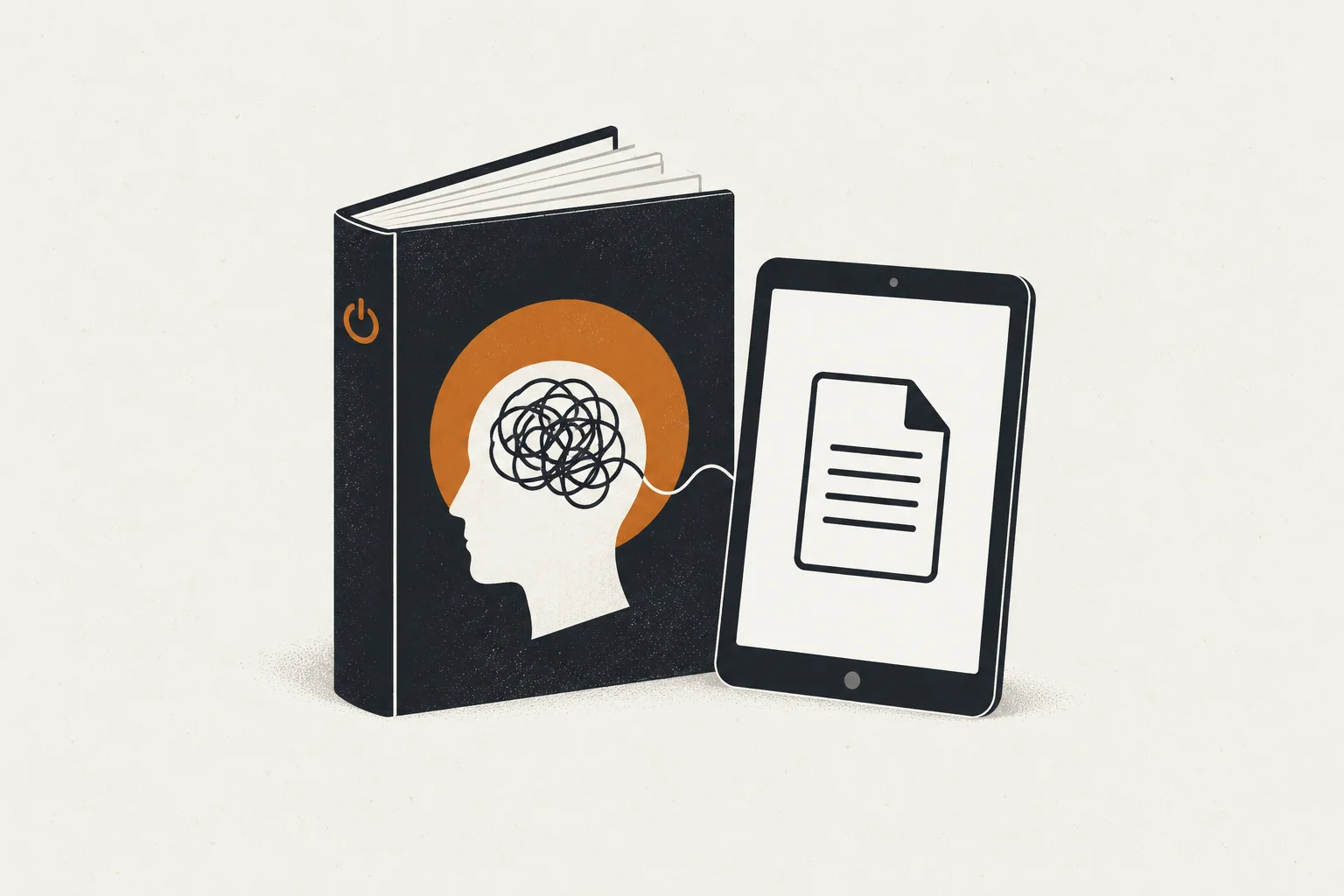
Top pick: Brain Off Switch: 100 Ways to End Overthinking
This book was designed specifically for the intersection of anxiety and overthinking. It offers 100 techniques organized by situation — morning anxiety, work stress, social overthinking, bedtime rumination.
Why it works for overthinkers: Overthinking creates the illusion that more analysis will solve the problem. This book gives you action-based alternatives — techniques you can deploy immediately without further deliberation.
Alternative: The Happiness Trap by Russ Harris — for readers who want to change their relationship with anxious thoughts rather than manage them.
For Anxiety with Depression
Top pick: Feeling Good by David D. Burns, M.D.
Anxiety and depression frequently co-occur. Feeling Good addresses the thought patterns underlying both conditions, making it a strong choice when you’re experiencing anxiety with low mood.
What you’ll learn:
– How negative thoughts create negative emotions
– 30+ cognitive distortions to watch for
– Practical exercises for changing thought patterns
– Behavioral activation techniques for depression
A 4-Week Reading Plan
Regardless of which book you choose, follow this structure:
Week 1: Read the first third. Take notes. Identify which techniques resonate with you.
Week 2: Begin the exercises. Start with easier ones — build confidence before tackling harder material. Track your anxiety levels.
Week 3: Increase difficulty. The exercises should feel uncomfortable. If they don’t, you’re not pushing hard enough.
Week 4: Evaluate. Are your anxiety symptoms improving? If yes, continue. If no, consider trying a different book or approach.
How to Know If a Book Is Working
Track these indicators weekly:
- Frequency: How often do you experience significant anxiety?
- Intensity: On a scale of 0–10, how intense are your anxiety episodes?
- Duration: How long do anxiety episodes last?
- Avoidance: Are you avoiding fewer situations than before?
- Functioning: Are you able to work, socialize, and care for yourself more effectively?
If you see improvement in 2–3 of these areas after 4 weeks, the book is working. If you see no change, it’s time to try a different approach.
When to Combine Books
Some anxiety patterns benefit from multiple approaches:
- GAD + overthinking: The Anxiety and Worry Workbook + Brain Off Switch
- Social anxiety + rumination: The Shyness and Social Anxiety Workbook + The Happiness Trap
- Panic + general anxiety: Panic Relief Now + The Anxiety and Worry Workbook
Don’t start multiple books simultaneously. Finish one before beginning another — or use them in complementary ways (one for structured work, one for quick reference).
Related Reading
- self-help books for anxiety — comprehensive guide
- best books for anxiety self-help — evidence-based rankings
- best self-help books for social anxiety
- self-help books for anxiety disorder
Key Takeaways
- Match the book to your anxiety type — GAD, social anxiety, panic, and overthinking each have different effective treatments
- CBT workbooks (The Anxiety and Worry Workbook, Mind Over Mood) remain the evidence standard
- ACT books (The Happiness Trap) offer an alternative for readers who resist traditional approaches
- Consistent practice matters — reading alone won’t reduce anxiety; you must do the exercises
- Give it 4 weeks — most books require consistent practice before showing results
- If it’s not working, try another — different approaches resonate with different people