Remedies for Sleep Anxiety: Breaking the Cycle of Worry and Insomnia
Sleep anxiety is the fear that you will not fall asleep, will wake repeatedly, or will not cope the next day. That fear can make bedtime feel like a test. The harder you try to force sleep, the more alert you become.
The most useful remedies for sleep anxiety do not promise instant unconsciousness. They reduce the struggle around sleep and rebuild a steady relationship between bed and rest. If bedtime anxiety keeps happening, cognitive behavioral therapy for insomnia (CBT-I) has stronger support than any single relaxation trick or supplement.
This article is educational, not medical advice. Sleep restriction and other structured CBT-I methods should be tailored with a qualified clinician when you have bipolar disorder, epilepsy, untreated sleep apnea, severe daytime sleepiness, or another condition that could make sleep loss unsafe.
Why anxiety can keep you awake
Sleep cannot be commanded. It becomes more likely when enough sleep pressure has built up, your body clock is aligned, and your brain is not treating the bedroom as a place of danger.
A difficult night can start a loop: you notice you are awake, predict a disastrous tomorrow, check the clock, and try harder. Those actions increase monitoring and arousal. Bed then becomes associated with effort and frustration instead of sleep.
This does not mean the symptoms are imaginary. A racing heart, tense muscles, and repetitive thoughts are real. The target is the loop that keeps them active, not a demand that you simply “calm down.”
What to do when bedtime worry starts
Stop measuring the night
Turn the clock face away and put the phone out of reach. Repeated time checks invite mental arithmetic about how many hours remain. That calculation rarely helps you sleep.
Use a neutral phrase instead: “I am awake right now, and I can rest without solving the whole night.” The goal is not to convince yourself that tomorrow will be perfect. It is to remove the emergency label from this moment.
Leave bed when wakefulness turns into a struggle
If you feel increasingly alert or frustrated, get out of bed. Sit somewhere dim and do a quiet activity, such as reading a familiar paper book or listening to calm audio. Return when sleepiness returns.
Do not treat a precise minute count as another test. The point of stimulus control is to keep bed connected with sleep rather than prolonged struggle. This is one component of CBT-I, which the American Academy of Sleep Medicine recommends strongly for chronic insomnia.
Downshift without demanding a result
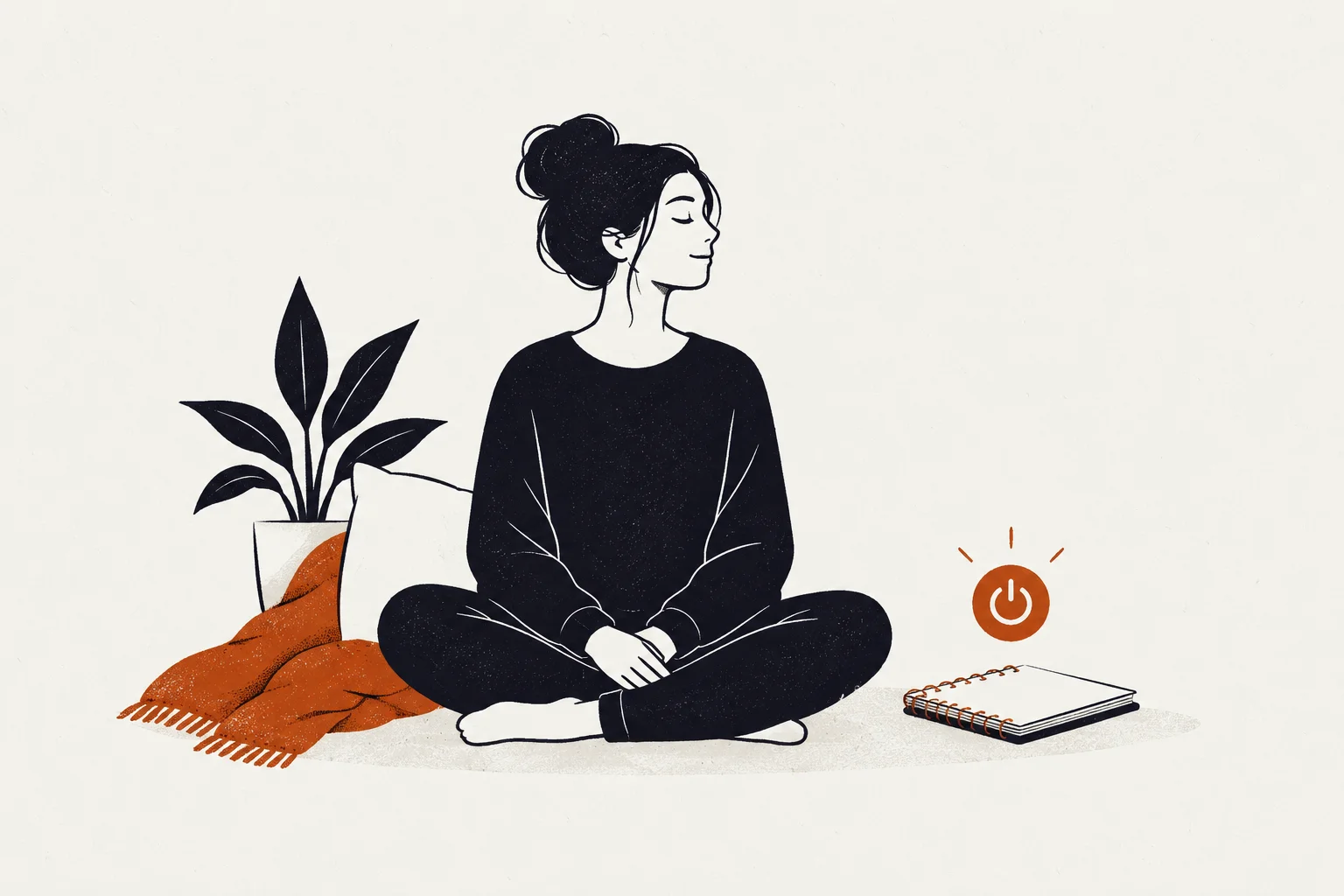
Try one low-pressure practice for five to 10 minutes:
- Slowly release the jaw, shoulders, hands, abdomen, and legs.
- Let the exhale be comfortable and slightly longer than the inhale; do not hold your breath if that feels unpleasant.
- Notice five physical sensations, such as the weight of the blanket or the temperature of the air.
- Write the worry and one next action for tomorrow, then close the notebook.
Relaxation can be part of CBT-I, but evidence for relaxation alone is limited. The National Center for Complementary and Integrative Health describes it as a possible supporting tool, not a cure.
Change the thoughts that add pressure
Sleep-anxious thoughts often sound absolute: “I will not function,” “I have ruined the night,” or “I must fall asleep now.” Arguing with them can create another battle. A more useful response is specific and credible.
| Pressure thought | More workable response |
|---|---|
| “Tomorrow is ruined.” | “Tomorrow may be harder, so I will simplify what I can.” |
| “I must get eight hours.” | “Sleep needs vary, and one night is not a verdict.” |
| “Nothing works for me.” | “I am testing a pattern over time, not judging one night.” |
| “I have to make sleep happen.” | “I can create conditions for sleep; I cannot force it.” |
Write the response during the day, not only at 2 a.m. Rehearsing it while calm makes it easier to remember when anxiety rises.
Build a seven-day reset
Nighttime techniques work better when the daytime schedule supports them. For one week:
- Keep a consistent wake time, including after a rough night.
- Get outdoor light after waking when practical.
- Avoid using extra time in bed to chase missed sleep.
- Move caffeine earlier and notice how long it affects you.
- Create a short wind-down that does not depend on doing every step perfectly.
- Record bedtime, estimated sleep time, wake time, and anxiety level once each morning.
The record is for patterns, not grades. Missing a day does not break the experiment. Resume the next morning.
Healthy routines matter, but sleep hygiene alone is not a complete treatment for chronic insomnia. The CDC advises regular schedules, a quiet and cool bedroom, and limiting evening electronics, while also recommending medical help for ongoing sleep problems.
When CBT-I is the better next step
Seek an evaluation when sleep difficulty happens at least several nights a week, continues for months, or affects daytime safety and functioning. A clinician can check for sleep apnea, restless legs, medication effects, mood conditions, pain, or other contributors.
CBT-I combines several methods rather than relying on sleep hygiene alone. It may include stimulus control, a carefully planned sleep schedule, cognitive work, and relaxation. In-person, group, and digital formats exist. A free starting point is the U.S. Department of Veterans Affairs Path to Better Sleep resource library, though self-help does not replace an assessment when symptoms are severe.
Get prompt help if you are falling asleep while driving, wake gasping or choking, have thoughts of self-harm, or experience periods of unusually high energy with little need for sleep.
The practical takeaway
The best remedies for sleep anxiety reduce monitoring, struggle, and catastrophic predictions. Tonight, hide the clock, leave bed when frustration builds, and use one gentle downshift practice. Over the next week, protect a steady wake time and track patterns without judging them.
If the cycle persists, CBT-I is the evidence-based next step. For a home-routine approach, see natural sleep home remedies. For the broader treatment question, read are there any cures for insomnia.