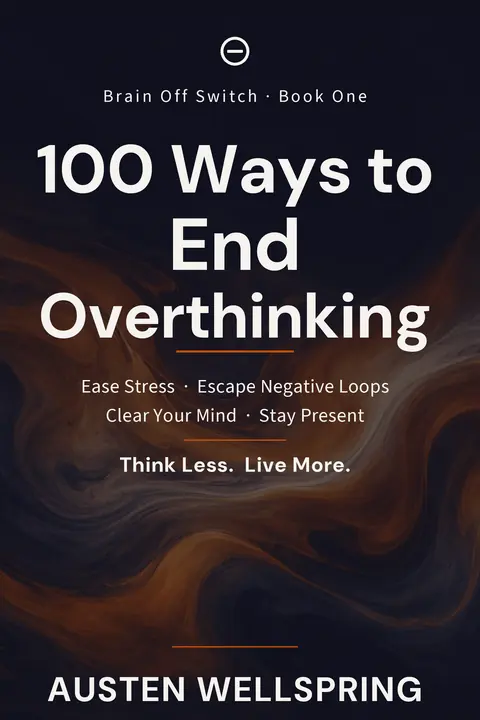
Brain Off Switch · Book One
100 Ways to End Overthinking
Ease Stress · Escape Negative Loops · Clear Your Mind · Stay Present
Amazon US Kindle price checked October 11, 2026; prices and availability can change. As an Amazon Associate, Brain Off Switch earns from qualifying purchases.
Most people think overthinking is just thinking too much. It isn't. Underneath the noise are three specific loops — and each one has a way out.
The three hidden loops
The book names what is actually driving the spiral, because you cannot step out of a pattern you cannot see.
Values Clarification
You overthink most where you care most. The mind turns loudest around relationships, career decisions, goals and identity — and tries to prevent regret by analysing every angle.
Future Self Dialogue
Spirals often come from fear: of choosing wrong, of failing, of not becoming who you want to be. The gap between now-you and future-you gets filled with predictions and imagined scenarios.
Timeline Sliding
Overthinking shrinks your world to the present moment, turning one situation into a permanent verdict rather than a passing weather system.
Who it’s for
If you have felt stuck in analysis paralysis, overwhelmed by what-ifs, or unable to quiet your mind, this is written for you. It is especially useful for:
- Professionals and decision-makers who need to cut mental fatigue and stay focused under pressure
- Students managing academic stress and burnout
- Creatives stuck in self-doubt, perfectionism or a block
- Perfectionists who want to use high standards productively instead of fearing failure
- Anyone whose thoughts race, and who needs tools to reframe them into something constructive
How to use it
This is deliberately not a book to read front to back. It is organised as a flexible toolkit rather than a linear journey, because the tool you need depends on where you are that day.
- Feeling anxious, overwhelmed or emotionally triggered? Start in the later chapters — they cover emotional regulation and symptom relief.
- Calm but stuck in a loop? Start early, where the rational-thinking and root-cause tools live.
- Best habit: use one technique until it stops being effortful, then move on. The tools get cheaper the more you use them.
What’s inside
Fifteen chapters and more than a hundred techniques, from cognitive tools you can use at a desk to somatic ones for the middle of the night.
- Layered Thinking
- The 6-Step Problem Solving Framework
- Stress Management Techniques
- Time Management Techniques
- Journaling Prompts: Reflect on Paper
- Rumination Management: Past vs Present
- Letting Go: Detachment Techniques
- Using Distractions as a Reset
- Develop Your “Me Time” for a Regulated Reset
- Breathing As Your Manual Reset
- Mindfulness for Overthinkers
- Healthy Habits for Cognitive Stability
- Socializing Without the Spiral
- Active Learning — The Absorption Framework
- Positive Self-Talk — The Narrative Debug Framework
Edition details
Get the book
Overthinking isn’t fixed by fighting it. It gets quieter when you have somewhere to put your attention.