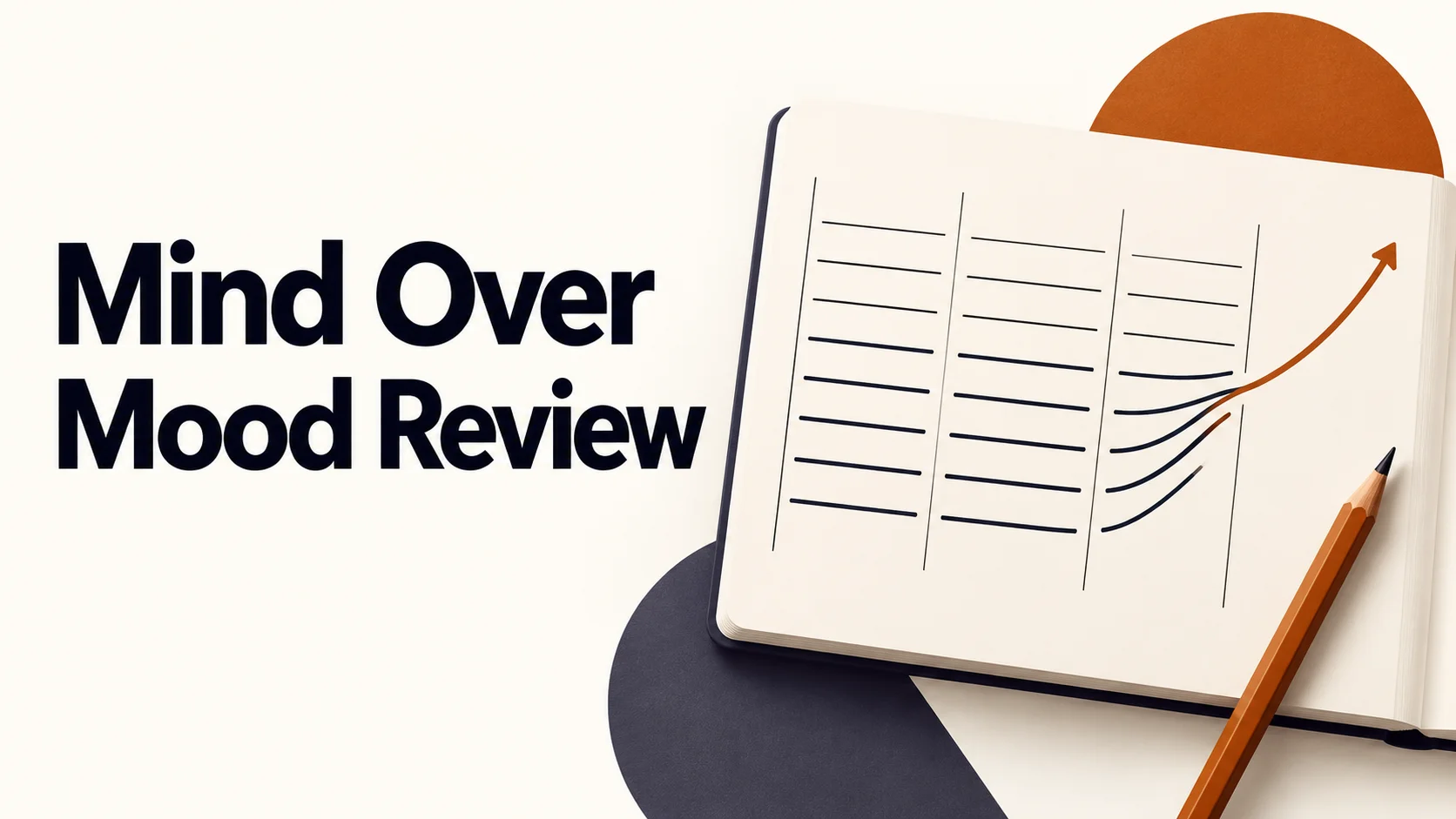
Mind Over Mood Review for Anxiety: Strong CBT Skills, With Limits
Disclosure: As an Amazon Associate I earn from qualifying purchases. This article contains affiliate links; if you buy through them, we may earn a commission at no extra cost to you.
TL;DR
Rating: 8.3/10
This Mind Over Mood review for anxiety finds a well-structured, credible introduction to cognitive behavioral therapy (CBT). Its thought records, progress tracking, and behavioral experiments turn abstract ideas into repeatable practice. The tradeoff is focus: this is a broad mood workbook with one anxiety-specific chapter, not a complete anxiety treatment plan.
Best for: Readers who want a systematic CBT workbook and can practice on paper over several weeks
Formats: Paperback, e-book and hardcover editions; current pricing varies
Key strength: A clear sequence from noticing thoughts to testing and changing patterns
Key weakness: The structure can feel like homework, and anxiety is only one of several conditions covered
Our verdict: Buy the second edition if you want to learn core CBT skills, especially alongside therapy. Choose a more anxiety-specific workbook if panic, phobias, or exposure work is your main concern. If a full workbook already feels like too much, start with one of these anxiety books for overwhelmed beginners instead.
Editorial transparency: This evaluation is based on the second edition’s published contents, official sample chapter, worksheet materials, author information, clinical guidance, and current research. We do not claim that a Brain Off Switch reviewer completed the program personally.
What Mind Over Mood is
Mind Over Mood: Change How You Feel by Changing the Way You Think is a self-help workbook by clinical psychologists Dennis Greenberger, PhD, and Christine A. Padesky, PhD. Guilford Press published the 341-page second edition in October 2015, with a 2016 copyright date. Aaron T. Beck, who developed cognitive therapy, wrote the foreword.
The book teaches CBT as a sequence of skills. You learn to separate situations, moods, thoughts, behaviors, and physical reactions. Then you examine the evidence for an automatic thought, build a more balanced response, make action plans, and test deeper assumptions.
The authors are credible guides. Guilford’s author profiles identify both as clinical psychologists with long CBT careers. Greenberger founded the Anxiety and Depression Center in Newport Beach, while Padesky cofounded the Center for Cognitive Therapy and codeveloped Strengths-Based CBT.
| Book detail | What you get |
|---|---|
| Authors | Dennis Greenberger, PhD, and Christine A. Padesky, PhD |
| Edition reviewed | Second edition |
| Publisher | Guilford Press |
| Length | 341 pages |
| Paperback ISBN | 978-1-4625-2042-8 |
| Formats | Paperback, hardcover, PDF e-book, and print/e-book bundle |
| Main approach | Structured CBT skills for anxiety, depression, anger, guilt, shame, and related problems |
What works for anxiety
The book makes anxious thinking observable
An anxious thought can feel like a fact: “I will freeze,” “something bad is about to happen,” or “I cannot cope.” Mind Over Mood slows that moment down. Its central thought-record process asks you to identify the situation, rate the mood, capture the automatic thought, review evidence, and form a more balanced view.
The value is not forced optimism. A balanced thought can still acknowledge risk. It simply stops possibility from masquerading as certainty.
This is particularly useful when worry arrives as a rapid chain of predictions. Writing the chain down gives you something concrete to examine. Our broader guide to CBT, ACT, and DBT books for anxiety explains why this approach suits some readers better than acceptance- or skills-based alternatives.
Skills build in a sensible order
The official table of contents moves from understanding problems and rating moods to thought records, action plans, behavioral experiments, core beliefs, condition-specific chapters, and maintaining gains. That progression matters. Many workbooks introduce a worksheet before the reader understands what it is meant to change.
Here, later exercises depend on earlier skills. The structure makes it easier to see why you are recording a thought rather than filling in boxes for their own sake.
The book also allows a condition-specific reading route. Its official sample chapter says readers can use the recommended chapter sequence for the mood they want to address instead of reading straight through. That flexibility helps, although the early foundation still deserves time.
The second edition gives anxiety more attention
The second edition expanded the anxiety material with fear ladders plus mindfulness and acceptance exercises, according to Guilford’s edition FAQ. It also added material on goals, progress maintenance, relapse prevention, and more effective use of thought records.
For a new buyer, the second edition is the obvious version. An existing first-edition reader who already uses the material successfully may not need to upgrade.
Reusable worksheets support practice
Purchasers can access 60 step-by-step worksheets, fill them in onscreen, and print them for personal use. The authors’ worksheet guidance recommends downloading individual sheets as needed rather than confronting one large packet.
That is good design for an anxious reader. One relevant page creates less friction than a 60-page stack.
The worksheets are not a bonus attached to the real book. They are the practice. Reading about a thought record without completing one is like reading about strength training without lifting anything.
Where the workbook falls short
It is not mainly an anxiety book
Only part of the workbook focuses directly on anxiety. Other sections address depression, anger, guilt, shame, relationships, self-esteem, and broader emotional problems. The transdiagnostic approach can help when anxiety overlaps with low mood, but it limits depth on any one anxiety disorder.
Someone with a specific phobia may want more exposure planning. Someone with panic may need clearer work on bodily sensations and safety behaviors. A reader with obsessive-compulsive symptoms should not assume a general workbook is a substitute for disorder-specific treatment.
Our list of the best CBT workbooks for anxiety is a better starting point if anxiety-specific depth matters more than learning a reusable CBT framework.
Thought records take concentration
The seven-column thought record is thorough. That is both the point and the problem. During high anxiety, identifying a precise thought, rating emotion, and weighing evidence can feel like an exam.
The answer is not to fill it out perfectly. Use one situation, one mood, and one thought. Stop after five minutes if your attention is gone, then return later. A partial record that you revisit is more useful than a pristine workbook you avoid.
If you are deciding between an exercise-led book and a conventional read, see our guide to anxiety workbooks versus traditional books.
CBT is supported; this exact workbook is not a guaranteed treatment
The evidence for CBT should not be confused with proof that one book will work for every reader. A 2025 unified series of meta-analyses evaluated CBT across several adult mental disorders. A 2024 network meta-analysis of psychotherapy for generalized anxiety disorder found CBT associated with reduced symptoms compared with treatment as usual. These findings support the treatment model, not a promise about this book.
Clinical guidance makes the same distinction in practical terms. The UK’s NICE guideline for generalized anxiety disorder includes CBT-based written self-help at a lower-intensity step and describes systematic work over at least six weeks. It recommends higher-intensity care when symptoms or functional impairment call for it.
What using the book asks of you
This is a workbook, not a comforting book about anxiety. Expect to write, repeat exercises, and measure moods over time. The publisher’s sample chapter explicitly emphasizes practice and patience over speed.
A realistic routine looks like this:
- Choose one problem. Do not try to repair every anxious pattern at once.
- Work for 10 minutes. Stop while the task still feels repeatable.
- Use one worksheet at a time. Download only the page you need.
- Bring confusion to therapy, if applicable. A clinician can help adjust the sequence or spot an unhelpful interpretation.
- Return after missed days. A gap is not failure. Resume with the last exercise that made sense.
The large print format gives the exercises room but is less portable than a standard paperback. The digital edition uses fixed pages, and the authors’ site warns that worksheets may be awkward on screens smaller than eight inches.
Price and value
The publisher’s product page lists several formats. Retail pricing can change.
| Format | Best for |
|---|---|
| Paperback | Writing directly in a physical workbook |
| PDF e-book | Using a tablet or printing selected pages |
| Paperback plus e-book | Keeping a desk copy and reusable digital worksheets |
| Hardcover | Libraries, classrooms, or heavy shared use |
The paperback is fair value if you will complete the exercises. If you mainly want an explanation of anxiety, a narrative book may offer better value because much of this purchase depends on active worksheet use.
Check the current price for Mind Over Mood, Second Edition on Amazon.
Pros and cons
Pros
- Builds CBT skills in a logical, cumulative sequence.
- Uses specific worksheets instead of vague reflection prompts.
- Covers thought patterns, behavior, goals, experiments, and maintaining progress.
- Includes 60 downloadable worksheets for purchasers’ personal use.
- Comes from two experienced clinical psychologists.
- Can support independent work or structured work with a therapist.
Cons
- Covers many emotional problems, so anxiety-specific material has limits.
- Requires more concentration and writing than a narrative self-help book.
- Thought records can become intellectual busywork if you avoid behavioral practice.
- The large fixed-layout format is inconvenient on a phone.
- No workbook can adapt to risk, diagnosis, or complexity the way a qualified clinician can.
Alternatives to Mind Over Mood
The Anxiety and Phobia Workbook — for broader anxiety coverage
Choose Edmund J. Bourne’s workbook if you want a larger anxiety reference with more emphasis on phobias, panic, relaxation, and exposure planning. It is more comprehensive for anxiety but also more imposing. We compare its place among other self-help books for anxiety disorders.
The Happiness Trap — if disputing thoughts makes you more tangled
Russ Harris teaches Acceptance and Commitment Therapy (ACT), which focuses less on deciding whether a thought is true and more on changing how tightly you hold it. It may fit readers who turn cognitive restructuring into another reassurance ritual.
A shorter, low-friction book — if bandwidth is the main problem
If worksheets feel impossible right now, choose a short book with standalone exercises. You can build the reading habit first, then return to a structured workbook. Lower friction is not a lesser form of effort; it may be the design that helps you begin.
Who should and should not use it
Best for:
- Readers who want a structured introduction to CBT.
- People whose anxiety overlaps with low mood, guilt, anger, or self-critical beliefs.
- Therapy clients who want organized between-session practice.
- Readers willing to write and repeat an exercise over several weeks.
Not ideal for:
- Anyone looking for a passive, cover-to-cover read.
- Readers who need a disorder-specific protocol for panic, phobias, obsessive-compulsive disorder, trauma, or another complex condition.
- People who find detailed self-monitoring increases rumination.
- Anyone in crisis or needing diagnosis, medication advice, or individualized treatment.
Frequently asked questions
Is Mind Over Mood good for anxiety?
Yes, if you want to learn general CBT skills and will use the exercises. Its second edition includes expanded anxiety content, fear ladders, thought records, behavioral experiments, and progress tracking. It is less suitable if you want a detailed program for one specific anxiety disorder.
Can I use Mind Over Mood without a therapist?
The publisher describes it for readers working independently or with a therapist. Self-directed use may suit mild or moderate difficulties, but that does not make it appropriate for every situation. Professional support becomes more important when symptoms are severe, worsening, complicated, or interfering substantially with daily life.
How long does Mind Over Mood take?
There is no honest universal finish time. The sample chapter says some material may take about an hour while other skills can take weeks or months to become automatic. Plan around practice, not a completion deadline.
Should I buy the first or second edition?
Buy the second edition if you are starting now. It expands anxiety material, thought-record guidance, goal setting, acceptance, mindfulness, and maintaining progress. An existing first-edition owner who already benefits from it may not need to replace it.
Does the workbook include printable worksheets?
Yes. Purchasers of the second edition can access 60 worksheets for personal use through the publisher link printed in the book. Copyright restrictions prohibit reposting or redistributing the files.
Verdict: a strong CBT foundation, not an anxiety cure-all
Mind Over Mood earns an 8.3/10 because it teaches a transferable process: notice the pattern, test the thought, change behavior, and track what happens. The authors’ experience, cumulative structure, and reusable worksheets make it stronger than books that stop at explanation.
It loses points because anxiety shares the book with several other concerns. Readers seeking a deep panic, phobia, or exposure program will outgrow its anxiety coverage. Readers with limited focus may never get far enough for the structure to pay off.
Buy it if you want a working education in CBT and accept that the worksheets are the work. Skip it if you need a light read, a condition-specific treatment manual, or a promise of quick relief. The best workbook is not the one you complete perfectly. It is the one you can reopen after a difficult week.
Rating breakdown
| Criterion | Score |
|---|---|
| CBT teaching and structure | 9.2/10 |
| Exercise design | 9.0/10 |
| Anxiety-specific depth | 7.1/10 |
| Accessibility during high anxiety | 7.5/10 |
| Author credibility and source quality | 9.3/10 |
| Overall value | 8.0/10 |
Medical disclaimer: This article is educational and is not medical advice, diagnosis, or treatment. A workbook cannot replace individualized care. If anxiety is severe, worsening, or disrupting daily life, contact a qualified health professional. If you may be in immediate danger, contact local emergency or crisis services now.